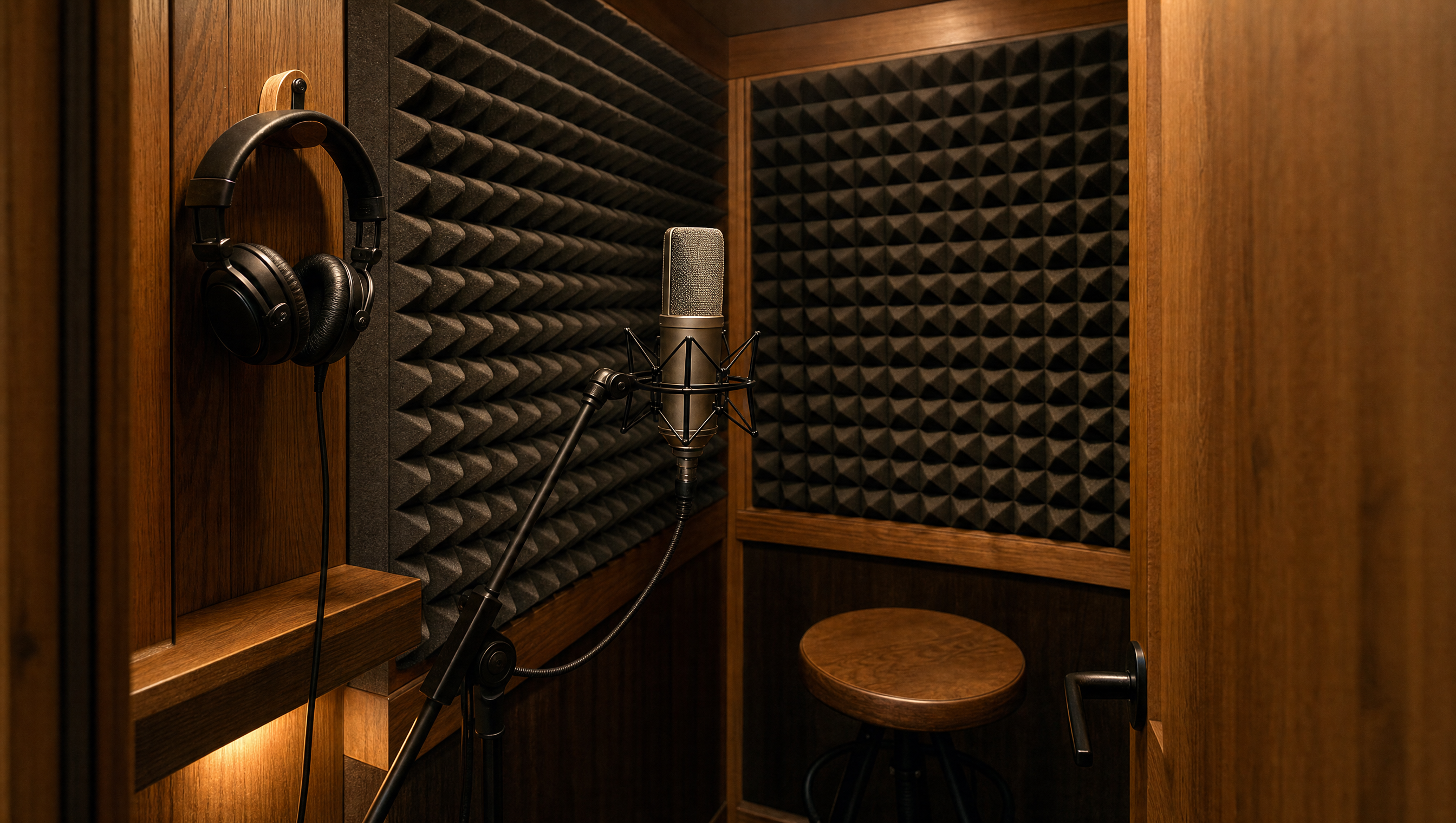
The vocal booth is a specialized acoustic space designed for one purpose: capturing the human voice with minimal coloration from the room. Unlike a live room, which contributes character to the recording, a vocal booth should be acoustically transparent. The microphone should capture the voice, not the space.
In practice, achieving this transparency is harder than it sounds. The tendency is to make the booth as dead as possible, covering every surface with absorption until there is no reverb at all. This is a mistake. An over-dead booth produces recordings that sound unnatural, lifeless, and difficult to mix. The voice needs a small amount of room interaction to sound like a voice in a real space, even if that space is invisible.
The Purpose of a Vocal Booth
A vocal booth serves three functions. First, it isolates the vocalist from external noise. The booth's walls block sound from the control room, neighboring rooms, and the outside world. Second, it controls reflections. Sound from the vocalist bounces off the booth's walls and returns to the microphone. Those reflections, if uncontrolled, create comb filtering and coloration. Third, it provides a consistent recording environment. Every vocal recorded in the booth has the same acoustic character, which makes it easier to achieve consistency across tracks.
The Over-Dead Problem
When you fill a small booth with acoustic foam on every surface, the resulting sound is dry. Too dry. The voice sounds like it was recorded in a vacuum. There is no air, no space, no life. When you add reverb later in the mix, the reverb sits on top of the vocal rather than blending with it, because the dry vocal has no spatial context.
This is the "dry room dilemma." You want the booth to be dry enough that the room sound does not interfere with the vocal, but not so dry that the vocal sounds unnatural. The sweet spot is a booth with a very short reverb time (0.1 to 0.2 seconds) that adds a subtle sense of space without being audible as "room sound."
A vocal booth should sound like a very small, very quiet room, not like an anechoic chamber. The voice needs to breathe.
Designing the Right Amount of Liveness
The key is selective absorption. Instead of covering every surface with absorption, leave some surfaces reflective. The result is a booth with controlled reflections that add a subtle sense of space without creating audible reverb.
A practical approach: cover the two side walls and the ceiling with broadband absorption. Leave the front and rear walls partially reflective, with a diffuser on the rear wall behind the vocalist. The floor should have a rug to absorb floor reflections.
This configuration absorbs the most problematic reflections (the side wall and ceiling reflections that reach the microphone at close range) while preserving a small amount of room interaction from the front and rear. The diffuser on the rear wall scatters sound rather than absorbing it, which prevents flutter echo without deadening the space.

Booth Size and Shape
The ideal vocal booth is large enough that the walls are far from the microphone. In a tiny booth (1 x 1.5 meters), the walls are so close that reflections arrive at the microphone almost simultaneously with the direct sound, creating severe comb filtering. In a larger booth (2 x 3 meters), the reflections arrive later and are more diffuse, which is less damaging.
If space is limited, the booth should at least be non-parallel. Parallel walls create flutter echo, a rapid series of reflections that produces a metallic ringing sound. Non-parallel walls (splayed at 5 to 10 degrees) break up the flutter and produce a smoother decay. If you cannot splay the walls, the rear wall diffuser becomes essential.
Microphone Technique in the Booth
The booth's acoustics interact with microphone technique. A cardioid microphone, the most common choice for vocals, has a proximity effect that boosts low frequencies when the source is close. It also rejects sound from behind, which means it picks up less of the rear wall reflection.
An omnidirectional microphone picks up sound equally from all directions, which means it captures more of the room. In a well-treated booth, an omni can produce a more natural-sounding recording than a cardioid because it does not have the proximity effect and captures a more balanced frequency response. But it requires a better-treated booth because it picks up everything.
Microphone distance matters. A closer microphone picks up less room sound. A distance of 10 to 15 centimeters with a pop filter is standard for lead vocals. For background vocals or spoken word, a slightly greater distance (20 to 30 centimeters) allows more room interaction and produces a more natural sound.
Monitoring in the Booth
The vocalist needs to hear themselves. Headphone mix is critical. If the vocalist's headphones leak into the microphone, it creates a delayed, filtered version of the backing track in the recording. This is especially problematic with open-back headphones.
Closed-back headphones reduce leakage but can be fatiguing for long sessions. Some vocalists prefer one-sided headphones or in-ear monitors. The key is to find headphones that isolate well enough to prevent leakage while remaining comfortable.
The headphone mix should include the vocalist's own voice with enough reverb to sound natural. Singing without reverb is difficult because the voice sounds dry and small in the headphones. A small amount of reverb in the monitor mix gives the vocalist confidence and improves the performance, even though the reverb is not recorded.
The Booth as a Tool
A vocal booth is not just a small room with foam on the walls. It is a carefully designed acoustic environment that balances isolation, absorption, and liveness. The goal is a recording that is clean and dry but not dead, that captures the voice accurately while preserving its natural character. Getting this balance right is what separates a professional vocal booth from a closet with foam.