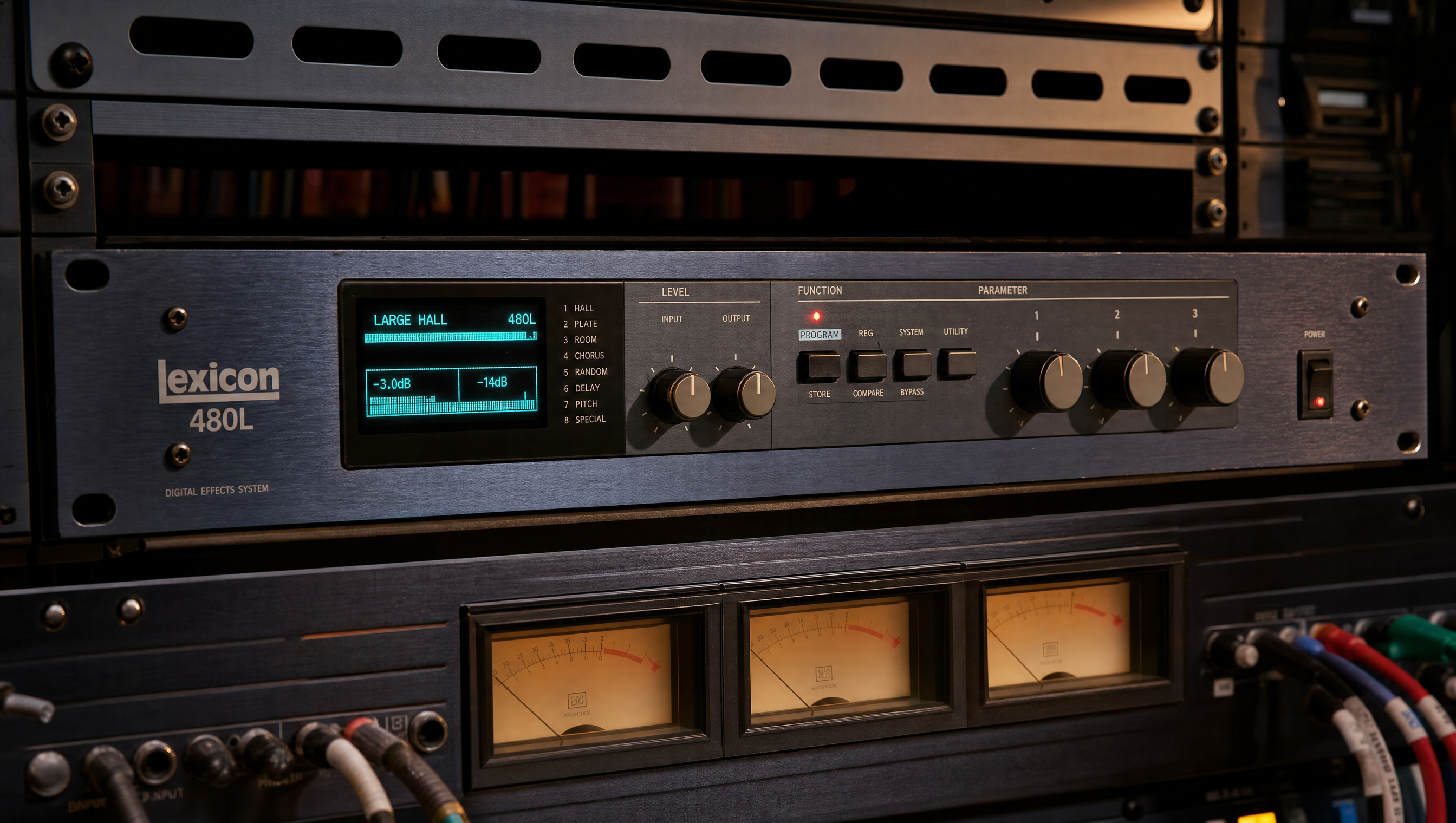
Released in 1978, the Lexicon 224 was the product that established Lexicon as the dominant force in digital reverb. Its algorithms, developed by David Griesinger, used a network of delay lines, allpass filters, and lowpass filters to create a reverb that was dense, natural, and free of the artifacts that plagued earlier digital systems. The 224XL, an updated version released in 1981, added more memory and improved algorithms.
The 224XL's sound is different from the later 480L. It is darker, grainier, and more "vintage" sounding. The converters have a grit that the 480L's cleaner converters do not. For many engineers, this grit is the appeal. The 224XL sounds like a record, not like a clean digital processor.
The Challenge
Recording the 224XL was not as straightforward as our earlier libraries. The unit's converters respond differently to different stimulus signals, and standard sine sweeps produced inconsistent results. Some frequencies excited the converters more than others, producing an uneven frequency response in the deconvolved IRs.
We had to develop custom stimulus signals specifically for the 224XL. These modified sweeps compensated for the converter response, ensuring that each frequency received equal energy. Designing and testing these custom sweeps took several weeks before we could begin recording actual IRs.
Beyond the stimulus design, we needed to locate a unit in mint condition. The 224XL is over forty years old, and many surviving units have degraded components. We found a unit that had been serviced and calibrated, with original converters and a functional LARC remote controller. We verified its performance against reference recordings before beginning capture.
The Library Structure
The L224XL IR Library consists of 597 unique impulse responses, sorted into seven categories:
- Hall 01: 87 IRs with a general hall setting, appropriate for all applications. A versatile starting point.
- Hall 02: 87 IRs with an alternative hall setting. Slightly different reflection density and decay character from Hall 01.
- Vocal: 87 IRs designed for vocal applications. Reflection delays are programmed to widen and stereoize the image. The reverb tail is slightly lowered but very audible.
- Orchestral: 87 IRs designed for orchestral instruments. Longer pre-delay and wider stereo image than the hall settings. Excellent for all instrumental applications.
- Plate 01: 93 IRs with a short plate algorithm for percussive applications. Reverb times ranging from 0.40 to 2.00 seconds.
- Plate 02: 87 IRs with a general plate algorithm for a wide range of applications.
- Ambience: 69 IRs with ultra-short settings. Reverb times from 0.20 to 1.30 seconds. Produces excellent stereo imaging. Also suitable for mastering.
Analog Recording Path
As with all our hardware libraries, the 224XL was recorded through its analog signal path, not its digital I/O. The 224XL's converters are a significant part of its character. The D/A output stage uses a ladder DAC with a gentle, warm rolloff. The A/D input stage, used when the unit processes external signals, adds a slight high-frequency emphasis.
Recording digitally would bypass both stages. The resulting IRs would sound cleaner but would not capture the 224XL's signature warmth. We chose fidelity to the hardware's actual sound over technical cleanliness.
The Two-Month Timeline
The library took two months from start to finish. The timeline broke down roughly as follows:
- Weeks 1-3: Custom stimulus signal design and testing. We created and tested approximately fifteen different sweep variants before settling on the final design.
- Weeks 4-6: IR recording. Each setting was captured with multiple sweep passes, averaged for noise reduction. The 597 IRs represent approximately 2,400 individual sweep recordings.
- Weeks 7-8: Post-processing. Deconvolution, trimming, normalization, noise floor verification, and format conversion. Each IR was individually checked by ear and by measurement.
Two months for 597 IRs. That is roughly six IRs per day. The pace was not slow. It was thorough. Every IR was verified, and any that did not meet our quality standard was re-recorded.
Compatibility and Modulation
The L224XL library is compatible with any convolution reverb that reads WAV files, with proprietary preset support for Altiverb, Waves IR1 and IRL, McDSP Revolver, TL-Space, Logic Space Designer, Structure, and Kontakt 2/3.
The 224XL, like the later 480L, uses modulation in its reverb algorithms. The library includes modulation delay presets for Pro Tools and Logic that recreate the chorusing. Users of other DAWs receive documentation to recreate the modulation in their preferred plugin.
Why It Was Worth It
The Lexicon 224XL is a historically significant piece of equipment. It was the reverb that made digital reverb viable, the processor that appeared on countless records from the late 1970s through the 1980s. Its sound is not replicable with modern algorithms because its character comes from the specific converters, the specific DSP architecture, and the specific algorithms that David Griesinger designed.
Working 224XLs are increasingly rare. The units that remain will eventually fail, and the custom components inside them cannot be replaced. This library preserves the sound of a specific 224XL, in mint condition, for anyone who wants to use it. That is worth two months of work.