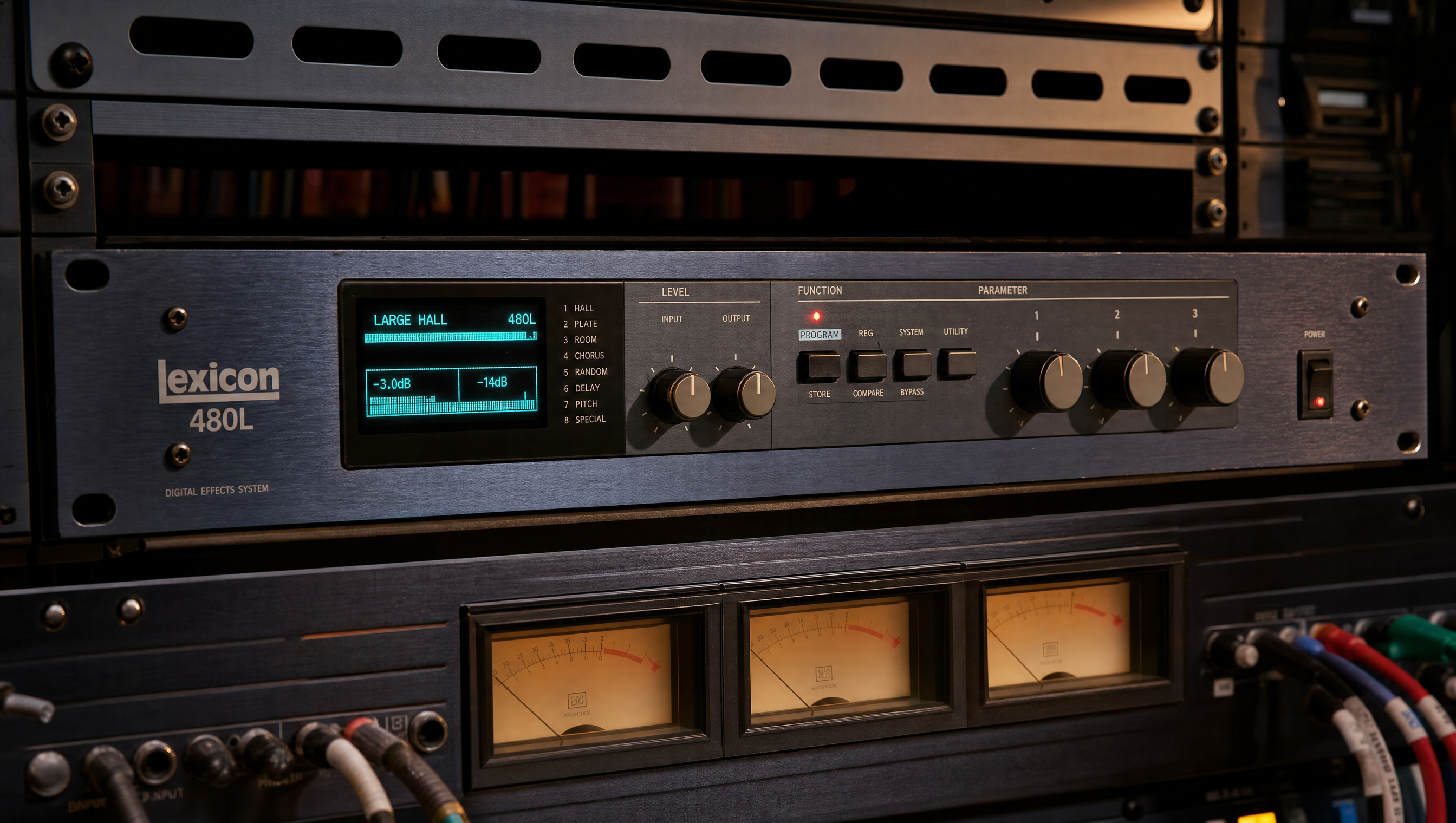
Released in 1989, the Lexicon 480L was the successor to the legendary 224XL and quickly established itself as the reverb processor in professional studios. Its algorithms powered countless hit records through the 1990s and 2000s. The 480L's sound is warm, dense, and smooth, with a decay tail that seems to float behind the dry signal rather than competing with it.
What makes the 480L special is not any single algorithm. It is the combination of its DSP architecture, its converters, and the musicality of its preset designs. The factory presets were tuned by ear over months of development, and they cover an extraordinary range from subtle rooms to vast halls.
Why Sample It?
The 480L is still available on the used market, but prices have climbed steadily. A unit in good condition now sells for between $4,000 and $7,000. Many units suffer from aging capacitors, failing displays, and noisy fans. Finding one in mint condition, with original converters and a fully functional LARC remote, is increasingly difficult.
Our library was recorded from a unit acquired in 2008 that had been serviced and calibrated to factory specifications. We verified its performance against reference recordings before beginning the capture process.
The Library Structure
The L480 IR Library consists of 711 unique impulse responses, organized into nine categories:
- Factory Presets: Every algorithm the 480L shipped with, captured exactly as they sound from the unit's outputs.
- Halls: Two distinct hall algorithms with varying decay times and reflection densities.
- Plates: Short and long plate algorithms, modeled on metal plate reverbs but with the 480L's characteristic density.
- Chambers: Echo chamber simulations, the workhorse reverb for vocal tracking.
- Churches: Extended decay algorithms with long pre-delay and sparse early reflections, simulating large worship spaces.
- Rooms: Studio room simulations at various sizes and absorption characteristics.
- Ambience: Ultra-short algorithms for adding space without obvious reverb. Ideal for mastering and source widening.
- Stereo Maker: A special category unique to this library. Four delay clusters assembled to provide width to any sound source, with variable delay time multipliers.
- Vocal: Reflection delays carefully programmed to widen and stereoize the image without obscuring the vocal.
The Analog Recording Path
Every IR in this library was recorded through the 480L's analog outputs, not its digital I/O. This was a deliberate choice. The 480L's D/A converters contribute a subtle warmth and roundness that is part of its signature sound. Digital capture would bypass those converters entirely, producing a technically cleaner but sonically different result.
The recording chain was: digital source (sine sweep) converted to analog by a high-quality interface, sent to the 480L's analog inputs, 480L analog outputs recorded back through the same interface. The sweep was deconvolved to produce the final IR.
To manage noise, each sweep was recorded multiple times and the results averaged. This reduced random noise by approximately 3 dB per doubling of takes. The final IRs have a noise floor at least 70 dB below the peak signal.
The Stereo Maker Algorithm
One category deserves special mention. The Stereo Maker is not a reverb algorithm at all. It is a technique we developed during the library's production that uses the 480L's delay architecture to create stereo width from a mono source. Four delay clusters are assembled with specific time relationships, and the delay multipliers are variable.
The result is a width-enhancement tool that sounds natural and does not produce the comb-filtering artifacts common to stereo widening plugins. It is particularly effective on mono synthesizer tracks, acoustic guitars recorded with a single microphone, and any source that needs to occupy a wider space in the stereo field without adding reverb.
Modulation and Chorusing
The 480L uses modulation in its reverb algorithms to prevent the buildup of static resonances in the decay tail. This modulation is part of what gives the 480L its lush, moving sound. An impulse response captures a static snapshot, so the modulation is not present in the IR itself.
To address this, the library includes modulation delay presets for Pro Tools (Short Delay II) and Logic (Chorus plugin) that recreate the modulation effect. Users of other DAWs receive screenshots and parameter documentation to recreate the modulation in their preferred plugin. Applying the modulation delay after the convolution reverb restores the moving, breathing quality of the original hardware.
The 480L's modulation is subtle but essential. Without it, the reverb sounds correct but static. With it, the reverb sounds alive.
Compatibility
The L480 IR Library is compatible with any convolution reverb that reads WAV files. In addition, proprietary preset support is provided for Altiverb, Waves IR1 and IRL, McDSP Revolver, TL-Space, Logic Space Designer, Structure, and Kontakt 2/3. With proprietary support, the IRs load directly within the plugin without manual import.
Legacy
The Lexicon 480L remains one of the most sought-after reverbs in existence. Its algorithms have been emulated in software, but emulations approximate the sound. A convolution IR captures it exactly. With 711 impulses covering every category the unit offers, the L480 library is as close as you can get to owning a 480L without spending five thousand dollars and hoping the power supply holds out.
For us, this library is also a time capsule. The unit we sampled is still working, but it will not last forever. When it eventually fails, the sound of that specific 480L, with its specific converters and its specific wear patterns, will be preserved in these impulse responses.